Showing posts with label Cambodia. Show all posts

Monday, January 14, 2013

Half-time

Beautifully made up bed in a dirty room

I can hardly believe I've been traveling for over three months already which marks my half-time. It seems both as if I've only started yesterday as well as like I've been on the road forever. I've fallen into a steady rhythm, going slowly, not trying to do too much too quickly but just enjoying the amazing places I discover.

I've stayed in various hotels/hostels/guesthouses/inns/lodges so far and some stories related to my accommodations have accumulated. I won't discuss how dirty the rooms are as we all know that Asia is dirty by default. Here are a few stories that stand out.

Bedbugs

I've encountered bedbugs only once. I can't say whether this is good in the sense that it happened only once or bad in the sense that it happened at all. They say that a bedbug bite doesn't kill you. This may be true as compared to mosquito bites that could give you malaria or dengue fever. But a bedbug bite itch is worse than anything I have ever experienced, it just goes on itching excessively for days. No more bedbugs, please.

Drugs

Many hotels display signs that drugs are not allowed. In Malaysia, being caught with illicit drugs carries the death penalty. In Laos, drugs are not allowed in hotel rooms but the managers remind travelers that if they must smoke something illegal, to please do it discreetly. In Cambodia, drugs are officially illegal as well, but are readily available, even advertised in the more touristy places. Police in Cambodia are so corrupt that they welcome the supplemental income of taking bribes for looking the other way when drugs are concerned.

Durian

No durian is allowed in hotel rooms or on public transport in most of southeast Asia. It's funny how a local guy commented: "When tourists come to southeast Asia, they say that durian smells bad. But what about French cheese?" Yes, he has a point.

Plastic bags

This one is my favorite. A sign in a dorm room said "No plastic bags allowed in dorm. Activities with plastic bags should be performed outside." I couldn't agree more. It's happened so many times, not only recently, but whenever I slept in shared bedrooms, there's always someone who gets up early and needs to pack and unpack and re-pack and rumble plastic bags to no end. I agree that activities with plastic bags in dorm rooms should be outlawed.

Showers

I found it hilarious when I read an online hotel review where a tourist complained about wet floors in bathrooms. What did they expect, don't they know that a shower in Asia means that a shower head is mounted above the toilet? Of course the floor is always wet as people shower in there. That's why everyone in Asia wears flip-flops.

Which brings me to the question: how can you tell the difference between an amateur and a professional Asia traveler? The pro knows from experience that toilet paper must be moved to a safe place before showering, otherwise it gets soggy.

Saturday, December 22, 2012

Leaving Cambodia

Cheers!

It's time to leave Cambodia. It's been ... what should I say? … I loved it? I hated it? I endured it? I was awed by it? I can’t summarize it with just one expression. It was a little of each. Mostly, I loved it. But still it bothers me. It’s so dirty. The streets are dirty. The establishments are dirty. And I’m not even comparing it to the Western world. I’m comparing it to Laos, the much poorer neighboring country. Despite its poverty, I didn’t see any garbage lying around in Laos. In Cambodia, it’s as if they’re saying “Hey, look at me, I’m poor and this gives me permission to dump my garbage however I want!”

Vendor at the fish market

The people seem laid back. They don’t hurry to do anything. Rather, they wouldn’t do much at all. They needed to be reminded repeatedly when I wanted anything, such as repairing the water heater, cleaning my room or refilling the water filtering device. But I know it’s just the way they are. Time flows more slowly in these parts of the world. They don’t hurry and they don’t stress out. As I already know from my experience in South Africa, the only way to blend into this environment is to go with the flow. Slowly, calmly, patiently.

I probably shouldn't generalize. I also dealt with many local people who work really hard. The enterprising tout in Kratie is an example. He sold me everything I bought there as he always seemed to find me when I was looking for something. I know I was paying him a commission for the bicycle rental and the bus ticket, but he saved me the trouble of finding it myself and I was happy to pay for his service. Also, the people at the organization where I work stay long hours and even come to work on the weekends sometimes. They really set an example and it gives me a greater sense of satisfaction that I volunteer my time where it is appreciated.

I met so many friendly local people, at work, at my guesthouse and even at a few places where I went to eat on a regular basis (I usually bought my mango shake from the same stall). Unfortunately, I don’t speak Khmer and most of the locals speak only basic English so it was difficult to have conversations, although I had the feeling that many of them, both men and women, would have liked to chat.

In addition to meeting local people, I enjoyed staying at the guesthouse and socializing with other volunteers who worked in various non-governmental organizations in Cambodia. They came from many different parts of the world, most of the them with the same purpose as me: to enrich our travel experience by helping the poorest and making a difference in the world.

Aerobics at the Olympic Stadium

I'm looking forward to returning to Cambodia in the future. If for nothing else, to do another round of aerobics on top of the Olympic stadium.

Thursday, December 20, 2012

Contrasts

Golden Dragon, Phnom Penh

Cambodia is a country of contrasts. It's not my original thought, I've heard it said over and over by people who have visited the country. Being here, I experience such contrasts every day.

There are modern skyscrapers under construction alongside basic shacks by the railroad tracks where the poor people live. Fancy restaurants with every world cuisine imaginable where a dinner likely costs upwards of 25 USD while a few steps away, at the central market, a main meal can be bought from a stall for 1,50 USD. Upscale beauty salons that advertise haircuts for 22 USD but I went to a local hairdresser to have my hair cut for 2 USD.

Modern air-conditioned cars drive on the roads, many of them huge 4WD models, with Toyota by far the most popular make. Among them, hundreds or perhaps thousands of locals on their motorcycles, tuk-tuks and bicycles wiggle their way, sprinkled with an occasional bicycle rickshaw powered by an emaciated old man.

While many of the local people are poor, making a living on a few US dollars per day, there are also those who overstepped poverty and seem to be living in relative comfort. The family who owns the guesthouse where I’m staying, for example. They send their two boys to an international primary school and they can afford to buy a remote-controlled helicopter for one of the boys on his birthday.

I also met an obviously well situated local young woman, a consultant where I work. She graduated in sociology from the Phnom Penh University and she consults on a freelance basis with non-governmental organizations in conducting surveys. Her background image on her laptop computer is one of her in front of the Universal Studios theme park in Singapore where she had been recently on vacation.

Many Cambodians dream of landing a job in Thailand, the region’s economic leader, where – if they’re lucky and find a job – they migrate to earn money to send back home to their families. Contrarily, I met Thai tourists traveling in Laos and Cambodia who seem to be dreaming of working “abroad”, wherever that may be. One young Thai girl asked me whether it would be possible to get a job in my country (not knowing or even caring where Slovenia is) because she had heard from her English teacher that “one Euro is many, many baht”.

I guess it all boils down to the fact that everyone is looking for ways to improve their standard of living, whether it’s to escape poverty or just to earn more money.

Monday, December 17, 2012

Bags of cash on a motorcycle


Company vehicle

I never imagined that my microfinance job in Cambodia would involve riding on a motorcycle with bags full of cash. As it turned out, that’s exactly what I did.

I accompanied an employee of the organization where I work to one of his microloan disbursement assignments. I was the passenger sitting behind him on the company-owned motorcycle. We drove on narrow paths through villages in the suburbs of Phnom Penh, trying to avoid fresh mud, chickens, small children and everything else that was in our way.

People gather around to witness microloan disbursment

We stopped at several houses where families had previously applied for microloans and had them approved. The money was handed over to the beneficiaries in stacks of cash. They had to sign the loan contract along with a guarantor. It is our organization’s policy that family members are not allowed to be loan guarantors, therefore the beneficiaries typically ask their neighbors to co-sign. The entire procedure becomes a huge village affair, because the neighbors have to be called and after that many people gather to watch, laugh, chat, and socialize in general.

Signing with a fingerprint
(The husband is signing. The wife
is pointing to instruct him how to do it properly.)

When my colleague pulled out a purple stamp pad, I assumed that he would stamp the papers with an official stamp. Surprisingly, people pressed their fingers against the pad and affixed their fingerprint to the loan contract. It was confusing to me because I believed that only illiterate people sign documents with fingerprints and it wasn’t my impression that Cambodians were illiterate.

Later, I asked the director of our organization about the fingerprinting procedure and he explained that according to Cambodian law all official documents - such as bank papers - have to be signed with a fingerprint.

"That's interesting," I commented. To which he replied incredulously, “Don’t you sign papers with a fingerprint in your country?”

“Um, no," I explained, "in fact I think it might even be illegal to take fingerprints by someone other than the police.”

It was now his turn to comment, "That's interesting."

I do wonder what good the fingerprints do them. For example, if a beneficiary was trying to flee the country to avoid repaying the loan, how would they catch her? Would they take her fingerprints at the border and then – just like in a CSI episode – scan the databases to see if she has any outstanding debts? I very much doubt that they digitize the fingerprints. The whole fingerprinting charade is probably a relic of some old regime.

Saturday, December 15, 2012

Unusual fruits


Fruits at the market

Although I’m not much of a fruit lover, I try to eat healthily while I travel and with the abundance of fruits at the local markets, I often end up eating fruit for lunch.

My favorite fruit remains the pineapple. I can get it almost everywhere, served nicely peeled and chopped in a bag with a wooden skewer. Occasionally I buy a mango, either the green and sour kind that they sprinkle with chili flakes, also served chopped in a bag, or the sweet orange variety, most often as a shake.

If I’m still hungry after just fruit, I supplement my lunch with a bunch of bananas. Sometimes it’s difficult to choose from the many varieties: small and yellow, large and green and everything in between.

I did make an effort to try the more unusual fruits that are found around here. There is the durian, the smelly fruit which I tried once and probably won't again. The taste is just as weird as the smell.

Durian

Sections of durian flesh

The rambutan is quite tasty as well as easy to peel and eat. It's very similar to lychee by taste but is more spiky on the outside.

Rambutan

Rambutan

The mangosteen is not one of my favorites, but the one I tried might not have been fresh as some of the inside sections were starting to turn brown.

Mangosteen

Mangosteen

The dragon fruit or pitaya looks much better that it tastes, in fact, it doesn’t have much of a taste at all. They often add it to fruit salads for its interesting pattern.

Dragon fruit

Dragon fruit

They serve coconut as a drink by drilling a hole and inserting a straw. It’s nice to try fresh coconut water once but I don't like the taste too much.

Coconut

They sell many more types of fruits, such as watermelons, mandarin oranges, grapes, apples and pears that are known to me as well as a bunch of others with which I haven't yet experimented and I still have no idea what they are.

Friday, December 14, 2012

Street hospital

Baby with intravenous drip exiting a clinic

I often see people with intravenous drips walking or riding the streets of Phnom Penh. It’s a strange sight that makes me wonder what are they doing outside of a hospital?

It makes more sense now that I’ve been told that people typically get drips for severe bouts of stomach problems and diarrhea. Children and babies are especially at risk for dehydration so they are the ones most frequently on drips. They don't stay in the hospital but are just sent home with everything attached.

I used to believe that only tourists have problems with their digestive systems when they visit Asia. But the locals get them just as well. They seem to just accept it, explaining that it’s a common ailment in this hot weather. I have been here long enough by now to realize why this most likely happens in hot weather. They don’t refrigerate the food and they let it spoil in the heat – and then they eat it. It’s no wonder they get sick. Unfortunately, they don’t seem to pay much attention to storing food in more hygienic conditions.

As for walking around with the drips, I’m also wondering how safe that is. What if the tube gets tangled and pulled? How hygienic is it to be outside in the polluted air? And they don’t just walk with the drips. As might be expected in a country where everyone goes everywhere on their motorcycle, they ride a motorcycle with the drip. It’s not unusual to see a family on a motorcycle where the father drives, the child with the drip sits in the middle and the mother sits in the back, holding the drip bag high above. I’ve also seen similar arrangements of three girls on a motorcycle, the middle one with the drip and the one at the back holding the bag. Sometimes, just two people ride, where one drives and the other holds their own bag.

The above photo depicts a frequent sight in front of a children’s clinic across the street from our guesthouse.

Wednesday, December 12, 2012

A wedding on our street


Wedding tent on our street

The blasting music jolted me awake. I remembered the wedding tent they were assembling on our street yesterday, but paid it no attention. They had my attention now, at 5:11 in the morning. Do they really get married this early? Yes, they do.

By the time I decided I wouldn’t be able to get back to sleep due to the loud music, got up and dressed and went down to the front terrace of my guesthouse for breakfast, the wedding was in full swing. Beautifully dressed people were returning in a procession from the temple where the wedding ceremony took place and were settling down in their tent for breakfast.

They told us that the music must be played so loudly so that everyone is aware of the wedding taking place. They did well in that respect. Everyone in our guesthouse was aware.

Wedding procession

Weddings – and funeral wakes – usually take place on the street. I often see similar tents in various streets in Phnom Penh, sometimes they block traffic and police are included in the wedding party to redirect traffic. It's so efficient, not having to book a banquet hall for the reception but just using the street

Christmas tree in my guesthouse
(other mandatory artifacts: beer, motorcycle, Buddhist shrine)

In addition to the wedding, another surprise awaited us this morning. The staff at our guesthouse decorated a Christmas tree for us. It was so thoughtful of them as they are Buddhists and don’t celebrate Christmas.

Monday, December 10, 2012

Speaking Slovenian on Otres beach

Otres beach

It was no coincidence I went to Mushroom point on Otres beach near Sihanoukville for the holiday weekend (Cambodia is very generous with holidays; in the five weeks I've been working here, three of them had holidays). I knew Mushroom point is run by people from Slovenia so I thought I would pay them a visit.

There were a bunch of Slovenian people, in addition to the three people who run the place there are two more Slovenians who work there, there was another tourist from Slovenia besides me and two more Slovenian guys who live in Sihanoukville where they operate a shoe factory dropped by for a drink. I could speak Slovenian again after two months on the road.

The touristy section of Otres beach

The area around Otres beach is full of hotels, guesthouses and bungalows, each with its beach bar, music, happy hour, cocktails and barbecues. But despite the concentration of tourist facilities – which were mostly full for the holiday weekend – it didn’t feel crowded. There is a lot of beach and walking just 5 minutes away from all the action it's completely empty.

The weekend was spent relaxing, drinking beer and chatting with all the Slovenian people who were gathered there.

Mushroom point is a bit on the expensive side for my budget. But I do allow myself the occasional luxury when I travel so for the two days I stayed there the cost was acceptable.

To clarify, in the context of traveling in Asia, “luxury” means that
  • my coffee is served in a cup that’s actually clean;
  • the faucet is attached to the sink, saving me the acrobatics of holding the faucet with two hands while at the same time trying to open the tap and wash my hands;
  • the drains drain and the drainpipes are attached to the sink so that water doesn’t shower down my feet when I run water in the sink;
  • the light switches are firmly screwed to the walls and they work;
  • no sparks fly when I plug in my computer.

But still, this is Cambodia. I was startled when one of the local employees at the guesthouse walked into my bathroom early in the morning, towel and soap in hand, apparently wanting to take a shower. It was my private bathroom for which I paid a fair amount of money. He was just as startled when he saw me, probably not expecting me to be up so early, and disappeared immediately. I’m sure he had been told not to use the guests’ bathrooms but if no one sees him, why not?

Friday, December 7, 2012

Beertasting German beers in Cambodia

The taproom

Kingdom Breweries is probably the only microbrewery in Cambodia. It originated in the Phnom Penh expat community, who raised capital and hired a German to make them decent beer.

They produce three types of beer: a pilsener, a lager and a dark lager. I tried them all at the monthly all-you-can-drink and all-you-can-eat beertasting event which also included a tour of the brewery.

Pilsener

Lager

Dark lager

The beers taste like German Bavarian beers as might be expected if a German makes them. They’re light and watery, well suited to the hot climate where a heavy beer wouldn’t go down as well. They produce more beer than the expat community can drink so they sell the surplus on the local market and even export some to Hong Kong.

The German brewer leads the tour

The German manager personally led the brewery tour. We found out that the factory equipment was designed in Germany, produced in Eastern Europe (he didn’t say which country) and delivered to Cambodia ready to be assembled. The malt and hops are all imported from Germany and the Czech Republic. He explained that barley and hops can’t grow in tropical climates therefore all beers that are produced in the tropics are either made from imported ingredients or from substitutes such as corn or cassava.

The accompanying food was burgers from Mike’s Burger House, a local fast food chain where I occasionally join other volunteers for lunch. A good thing I decided to take a break from eating rice every day, twice a day by going for a burger. That’s where I found out about the beertasting.

Tuesday, December 4, 2012

Running the Angkor Wat Half Marathon was the best decision I ever made

I did it!

Running the Angkor Wat International Half Marathon was The. Best. Decision. I. Ever. Made. In my life.

If you had asked me a month ago, or even a week ago, I might have said, “Registering for the Angkor Wat Half Marathon was the stupidest decision I ever made!”

Back home in September, when I was searching the internet for running events, it seemed such a good idea. I was going to be in Cambodia in December and there was a half marathon and why not, let’s register.

When I arrived in southeast Asia at the beginning of October, it hit me: how am I ever going to run in this oppressive heat and humidity? Why did I so stupidly register without checking the weather first? Who runs marathons in such humidity anyway?

What to do? How am I going to train? I could still skip the race, I thought. I didn’t tell many people that I was registered so I wouldn’t have to deal with too much humiliation by admitting failure. I could look for air-conditioned gyms near where I was staying and run on the treadmill. Or I could grind my teeth and bear it. The marathon itself would take place in such weather and I might as well get used to it.

So I did.

***

Picking up my race number
with a map of the course behind me

We arrived in Siem Reap, the nearest town, a few days prior to the race for sightseeing. Another volunteer who works in Phnom Penh was entered in the 10 km race and we came together. My roommate also joined us, as the cheerleading squad and photographer.

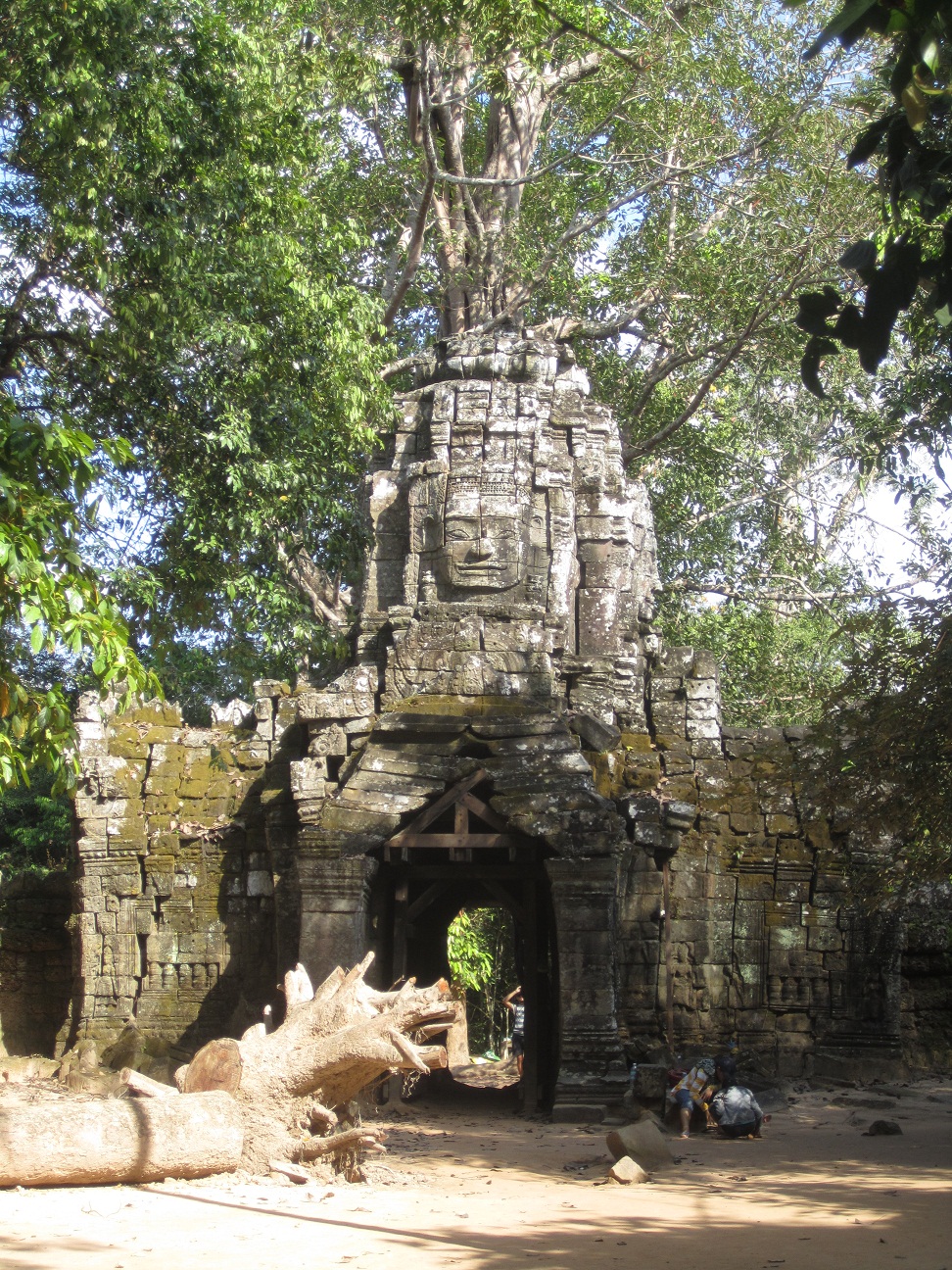
On the Thursday before the race I could see they were already setting up the course. I noticed the 18 kilometer mark in front of the Bayon temple. In front of the Bayon temple! I can’t believe it, this is where I’m going to run? In the ancient city, passing by the awesome temples. I must be dreaming.

***

Race day.

Warm up

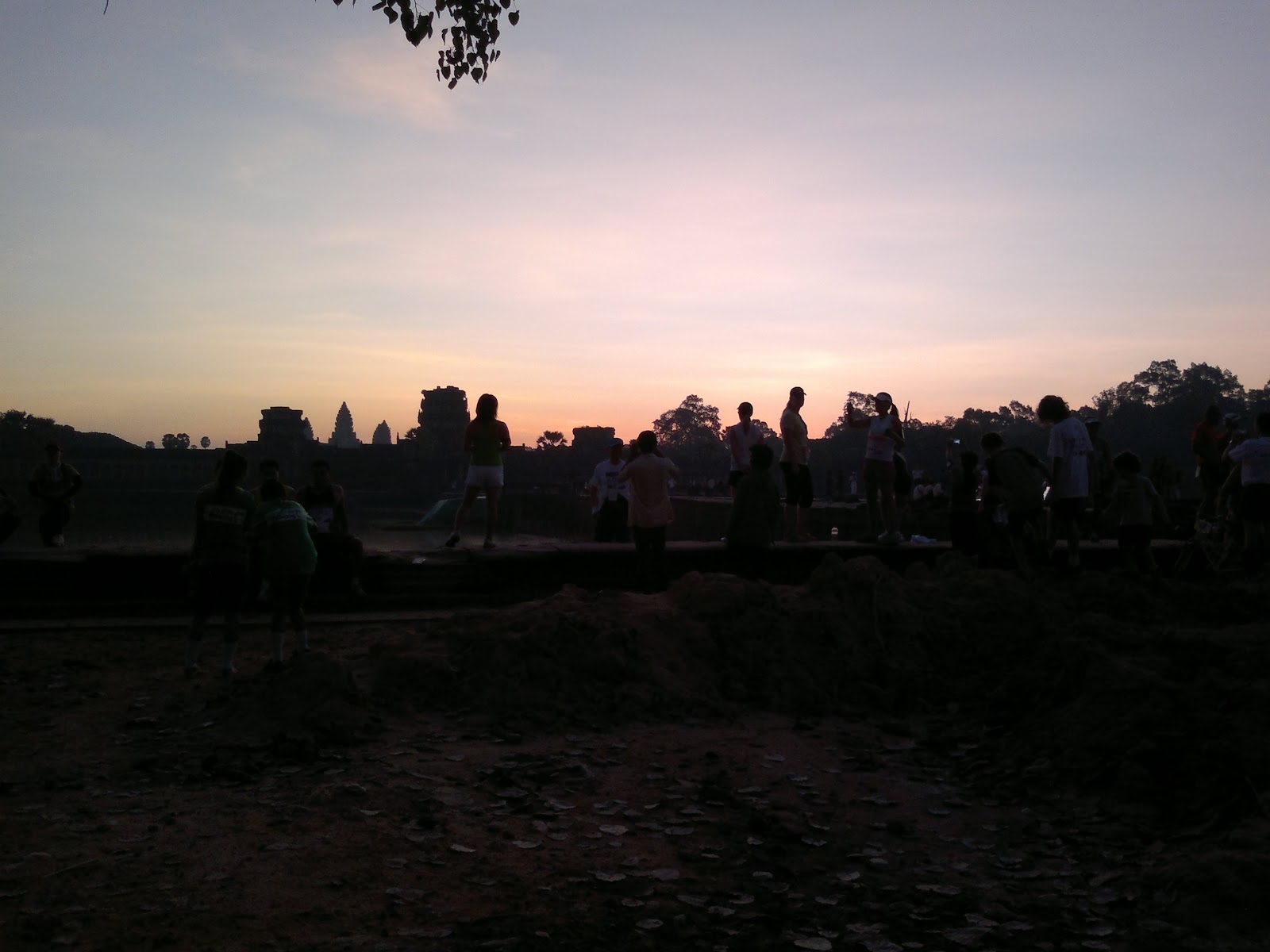
It’s dawning when we arrive. Warm up in front of Angkor Wat.

Start. Our tuk-tuk driver cheers me on.

3rd kilometer, 19 minutes. When did that happen, where did the first three kilometers go? I’m going too fast, my pace should be 7 minutes per kilometer.

I’m flying, I feel invincible, I know I’m going to finish this race. I’m running at Angkor Wat of all places! Nothing could stop me now.

The first water station. They distribute half liter bottles of water. I take the bottle, drink some and carry the rest with me, drinking as I go.

5th kilometer, 32 minutes. Too fast. Slow down. There’s still a long way to go.

I’m sweating by the bucket. Water stations are plentiful. I gulp down the entire half liter bottle at the next station. All together I drank five bottles during the race.

7th kilometer. I run beside an Asian guy. His backpack is talking to him, “You have run 7 kilometers in 47 minutes and 21 seconds.”

The kilometers fly by in a blur, I notice them but I stop counting. Children along the way give us high fives.

I let my imagination run wild. Once again, I’m Lara Croft (I know, I watch too many action movies), chasing bad guys while behind me giant trees with roots like octopus tentacles are grabbing to strangle me. OK, wake up. It’s just a running race.

Victory gate

16th kilometer. The Victory gate entrance into the Angkor Thom city. Do I run or do I stop to take a photo? Who cares about my finish time, I have to take the photo. My hands are sweaty and I fiddle with the touch screen on my phone. There isn’t a square centimeter of dry clothing on me where I could wipe my hand. I wave in the air to dry so I could operate my phone.

Dropouts at the Terrace of Elephants

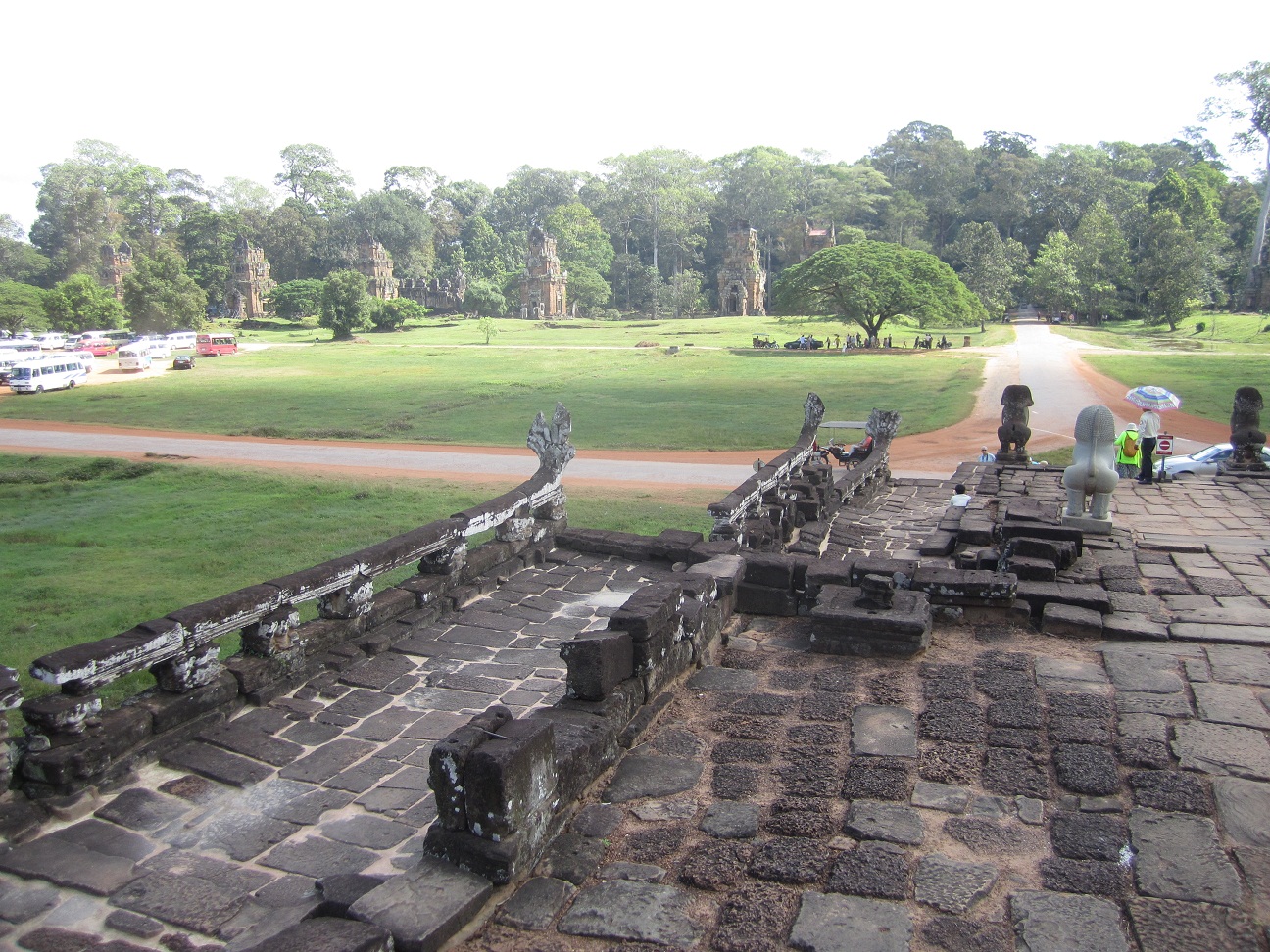
17th kilometer. The Terrace of Elephants. Another photo, my finish time doesn’t matter any more. The couple in front of me are debating dropping out of the race. They go straight up the stairs onto the terrace, sightseeing. Forget the race.


Taking photos in front of the Bayon temple

18th kilometer. The Bayon temple. Another photo opportunity. I take a photo of other runners taking photos.

Tourists are approaching

19th kilometer. It’s now close to 9:00 AM and the tourists are pouring in. They take photos of us runners. We must have been a tourist attraction, some crazy people running in such heat.

20th kilometer. I can see Angkor Wat, almost there.

Finish!

My certificate of completion

My time wasn’t the best ever but I still placed 526th out of 840 women finishers. I’m thrilled! The winner of the women's race was from Sweden, of all places. How does a Swede win a marathon in Asia is beyond me. Perhaps she lives here.

Now what?

My original plan was that if I survive the Angkor Wat Half Marathon, I wouldn’t run any more while I’m traipsing around hot and humid Asia.

But I’m too excited. It was so amazing, I can’t believe I did it! Nothing hurts, I’m not even tired. Let’s Google for more running events in the near future. Stay tuned…

***

U.K., the official chauffeur

Despite my elation, there was someone else who was the happiest person alive on race day. Look at U.K., our devoted tuk-tuk driver, he’s grinning from ear to ear. Not every tuk-tuk driver gets the honor of being the official chauffeur for a Marathon. He was even more excited to be there than we were. And he takes tourists sightseeing every day, he must have seen the temples hundreds of times. But seeing his tourists run - that was a once in a lifetime event for him.

Sunday, December 2, 2012

More temples of Angkor

The second day at Angkor was more of the same. Temples, more temples, more trees strangling the temples, more busloads of Chinese and Korean tourists...

Some highlights:


Our guide made us go up the Phnom Bakheng hill to view the sunset about two hours before sunset because there is a limit to how many people can be there at a time and they close the entrance when the limit is reached.

Normally, I wouldn't mind a 20 minute hike up a hill. But it was so awfully hot and I was exhausted after two days of temple hopping, I was enviously eyeing the tourists who hired elephants to take them up. (No, I walked, why do you ask?)

Waiting for the sunset


Sunset over Angkor Wat

We could have continued sightseeing a third day. But, there is only so many temples you can photograph and only so much heat you can endure.

Saturday, December 1, 2012

The temples of Angkor

Now I know why it takes at least three days to visit the temples of Angkor. There are so many!

First, there is the Angkor Wat itself, the famous temple. But that's just the tip of the iceberg. Behind it lies Angkor Thom, an immense ancient city, forgotten in time and half eaten by vegetation. At its peak, during the great Khmer empire between the years 802 and 1432, the city housed around a million people. It was one of the greatest civilizations of its time.

Here is a brief photo summary of what we saw on the first day:

Victory gate, one of the entrances to Angkor Thom

Bayon, the temple with many faces in the center of Angkor Thom

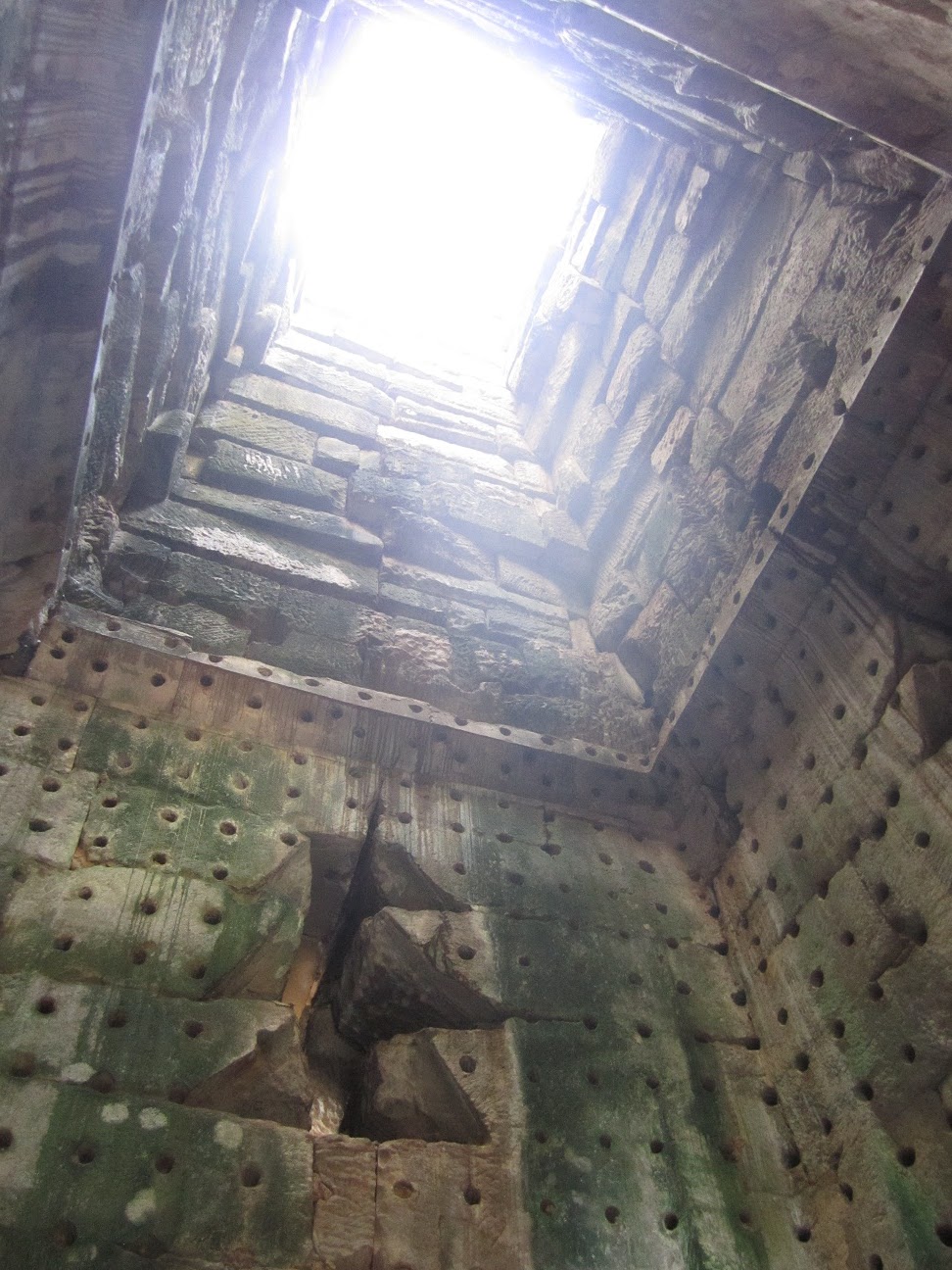
Inside Bayon

Baphuon, the king's temple

Royal swimming pool
Gods of death in the royal crematorium

Terrace of Elephants


View from the Terrace of Elephants, the king's stage

Next up, Ta Prohm, where parts of the movie Lara Croft: Tomb Raider were filmed. Needless to say, the temple was packed with tourists. Additionally, it's under massive reconstruction and many areas are inaccessible.


And for the grand finale of the day, Angkor Wat.


Detail on the wall

Stairs to the upper level

Upstairs

Apsaras, heavenly goddesses

And that's just the first day. Want more?

To be continued...