Tuesday, August 30, 2011

Scandinavia


For this year's vacation Marko wanted us to go up north, where it is cooler than back home and much cooler than it was on our last year’s vacation. So we went to Sweden and Norway by car. I knew it was going to be cold so I took warm clothes with me but if I had known in advance how really cold, windy and rainy it would be, I might have reconsidered the whole trip. But after driving about 1.400 kilometers to reach the south of Sweden to find out how cold it really was there I didn’t see it worthwhile to turn back and go home.

Although it was my first trip to Scandinavia, I have to say that traveling in Europe is much less exciting compared to traveling in Asia or Africa. Everything seems the same as back home. But there were still a few first impressions so I will take them one by one.

Cold. I know I said it already and I am sure I will repeat it many more times. I was seriously surprised at how cold it really was even though it was August and the average daily temperatures were supposed to be around 20 degrees Celsius. When we arrived, it was cloudy, windy, damp with no sign of the sun and the temperature was definitely below 20 degrees. Sure enough, some of us tourists were dressed in all the jackets and sweaters we brought along whereas the locals were frolicking around in sundresses, shorts and tank tops. I’ve heard before that the Scandinavians have a much higher tolerance for cold and now I saw that it is all true. Thankfully they at least didn’t swim in the lake which would have made me shiver for sure.

We stayed in a campground on a lake near Höör, a small town. There is a beach on the lake and it looked like they were charging admission to the beach on the lake. But the entrance booths were ominously deserted and the gate to the lake was wide open so it seemed that no one bothered to collect admission. It was the last weekend of the high season after all and the beach with small rental boats seemed packed up and ready for the winter. No one was swimming because it was already too late in the season and too cold for beach activities. So much for our summer vacation. I went running to warm up a little and I noticed that even the horses that were grazing around the lake were covered in blankets. I knew I was in a lot of trouble as far as cold was concerned when even the horses needed protection.

Prices. We had been warned about high prices in Scandinavia. That is why we decided to camp with a tent and try to cook our own meals as much as possible. While it turned out true that eating out is outrageously expensive in Scandinavia and a cup of coffee in a restaurant in the city might cost as much as 4 EUR or more, I was surprised to find out that food in supermarkets was comparably priced to what we are used to in Slovenia. I bought fresh fruit and vegetables on the first day and saved the receipt so that I could compare prices when I returned home. It turned out that the 4,11 EUR that I paid at a supermarket in Sweden would have cost me 4,03 EUR in my local store back home for exactly the same items. The next morning we discovered an all you can eat breakfast buffet in a bakery in town for 5,45 EUR per person including coffee and juice which seemed more than reasonable to us. So at least we weren’t going to go bankrupt on food after all.

IKEA. No surprise, a visitor couldn’t possibly miss IKEA in Sweden. The first thing one sees immediately after crossing the Øresund Bridge from Denmark into Sweden is an IKEA store. Each city in Sweden and Norway has at least three IKEA stores. Although I had no intention of buying furniture while I was on vacation I still wanted to visit a store just to see if it was the same as the Austrian one I am used to. The store was much larger but still had exactly the same items on display, only more of them, for example, each piece of furniture was on display in all the various available colors and finishes.

Monday, May 2, 2011

Slovakia

Slovakian countryside

After Hungary, Marko and I continued our holiday weekend across the Danube River into Slovakia, the country that is most often confused with Slovenia. We drove along the beautiful countryside which was bright yellow due to flowering what I believe to be rapeseed, a plant that is widely cultivated in the region and from which they make biodiesel fuel.

Rainy day in Terchova

We planned to visit the mountainous region of the Low Tatras National Park in the north of the country so we settled in the town of Žilina. We spent the night in one of those huge hotels that were built during the Soviet era and are now deteriorating, similar to what we had seen on our trip to Azerbaijan and Georgia last year. We didn’t even bother to ask if they have internet access but were quite surprised when we later discovered that there actually was a WiFi connection. The next morning we were going to do some hiking around the town of Terchova which is the starting point for hikes in the summer and for skiing in the winter. Unfortunately it was raining and there was nothing much to do than to drive around a little and move on.

Castle of Trenčin

We continued our journey to Trenčin, another picturesque town with a castle on top of a hill. We found out that our visit to Slovakia coincided with the world ice hockey championship. In a country that seems obsessed with ice hockey they had large screens put up in every main square in every town where the people gathered in the evenings to drink beer and watch the games. We caught a game where Slovenia was playing (and lost) against Russia.

Watching ice hockey

We tasted probably the worst beer in the world. It seems funny how Slovakia, neighbor to the Czech Republic – which is famous for its beers – manages to make such bad tasting beers. We spent the night in Trenčin, expecting that due to the sports activities in the capital city of Bratislava we might not be able to find a decent place to sleep.

Ice hockey stuff in Bratislava

On the last day of our trip we drove into Bratislava where there was no way we couldn’t notice the ice hockey stuff everywhere. Fans of Finland and Latvia were seen on the streets and in the pubs (the match between Finland and Latvia was that night), there were statues of hockey players with game schedules placed in various places around the city, they sold hockey souvenirs on the streets and the supermarket was stocked especially with fans in mind with towers of beer and vodka catering to their tastes. Among all that chaos we also managed to go up to the city castle and see a few sights as well.

Bratislava castle

Saturday, April 30, 2011

Budapest & around

View of Budapest

I spent the May Day holiday week in Budapest, Hungary – partly for business to attend a conference and partly for leisure. I was able to explore Budapest during conference breaks. Everything is within easy walking distance and the weather was sunny and warm so I really enjoyed myself.

Wine tasting

On Friday afternoon Marko joined me in Budapest.While strolling through the old part of the city and looking for a place to eat we discovered a Balaton wine festival. We tasted various wines from the Balaton lake region and ended up staying there for the rest of the evening.

Višegrad

On Saturday we drove northwest along the Danube river. Our first stop was the town of Višegrad where we visited the ruins of a fortress. We noticed signs that there are many bicycle trails around Hungary and we thought it might be nice to visit the country with a bicycle someday.

Basilica in Esztergom

Our next stop was Esztergom, another picturesque town with a huge basilica where we strolled around and had nice views of the Danube and of Slovakia just across the river.

Wednesday, January 26, 2011

Rome

The Colosseum

Rome, Italy is one of those places that topped my list of places I wanted to visit. But as the capital city of my neighboring country it never seemed exotic enough to make it a vacation destination. On the other hand it is too far away to make it a day trip. My mind was finally made up when I recently came across the information that Italy has high speed trains (how come I didn’t know that before?). There are daily direct trains from Venice to Rome almost every hour with a travel time of under 4 hours. Adding to that 2 hours that it takes to drive from my home to Venice it means the entire trip is 6 hours in one direction. Thus Marko and I decided to finally go on an extended weekend trip.

Frecciargento, the high speed train

I expected that Rome is warmer than Slovenia even during the winter month of January. True, they have tropical plants growing outside which indicates that temperatures hardly ever drop below freezing. But choosing January as the time to go was probably a little too extreme as temperatures were just barely above freezing. It was also raining some of the time but we managed to escape into museums and catacombs during the worst downpour. On the bright side it was low tourist season so that we managed to avoid the worst crowds. Even so the Sistine chapel and the Fontana di Trevi were surrounded by tourists so I really wonder how busy it must be during the high tourist season.

View from St. Peter's basilica

We had no real plan what we wanted to do or see in Rome, so we just made rounds of the major sights: the Vatican with St. Peter’s basilica, the Vatican museums with the Sistine Chapel, we had a stroll along Piazza Navona, we crossed Piazza del Popolo, and saw some important churches, palaces and buildings along the way. Obviously we couldn’t miss the Colosseum and the adjoining Roman Forum. One day trip was to take a bus to the old Appian Way and visit the catacombs. When in Rome it was also impossible to miss trying all the great Italian food: pizza, pasta, Chianti, grappa, limoncello.

Piazza del Popolo

My strongest impression of Rome: they have Egyptian obelisks on every square. It seems as if every Italian seaman who ever went to Egypt returned home with an obelisk.

Saturday, October 16, 2010

Home alone II

Once again, just like in March this year, I was home alone because Marko was on a business trip and Matej went on a school trip. So I set out to finish what I started in March, that is to hike in the Kamnik Alps.

I think I made it just in the nick of time as it was probably the last day with nice weather before the rains start again tomorrow and the forecast is that it would snow above 1000 m altitude which means the Kamnik Alps will be under snow once again.

I was hoping for some sun which unfortunately did not happen, it was mostly cloudy and foggy. I was surprised to see that there was frost on the grasses when I approached the mountain hut on Kamniško sedlo. The frost didn’t go away even when I was leaving at around noon so this is definitely a sign that winter is just around the corner.

Despite the cloudy weather the scenery was still beautiful due to the rich autumn colors.


Sunday, September 12, 2010

Planika

The original idea was to climb Triglav, the highest mountain in Slovenia (2864 m) with my co-workers. But we could not get accommodation in one of the mountain huts below the summit as on this particular weekend every bed was sold out weeks ago. So a two day trip was out of the question. While it is possible to do the Triglav climb in one day, we would have had to to start out much earlier than we did and go much faster. We made it as far as the Planika mountain hut at 2401 m elevation. There we decided to return and go back to be safely back at our car before dark and made plans to make another attempt next year.
It was a perfect September day, sunny and not too hot. The views were spectacular as always.
We were lucky to see an Edelweiss flower, a protected alpine flower.
And we also saw a groundhog, also a rare sighting so I was excited that I caught one on camera.

Monday, September 6, 2010

Tbilisi

Looking back it is as if the only reason we went to Tbilisi was to eat hachapuri, or, as one fellow traveler put it: "Can you eat too much hachapuri?" No, I assured her. Hachapuri is a savory pastry filled with cheese and you can buy it from a roadside stall or order it in a restaurant, you can have it for breakfast, or for lunch, or for dinner, or sometimes for more than one meal in one day. Luckily, there is a Georgian restaurant in Ljubljana, conveniently located just a few minutes walk from where I work and they have hachapuri on their lunch menu so I was able to gradually wean myself off the hachapuri addiction after I returned home.

In Tbilisi we checked out the fortress (yes, it is on top of a hill and yes, I dragged Marko up there for the views but in my defense I didn’t drag him up the other hill with a TV tower and a Ferris wheel). We also strolled in the botanical garden but we decided to skip the museums. Compared to Baku, Tbilisi seems as if it still has a long way to go to become a modern city as there are so many buildings, especially in the old part of the city, that are literally falling apart. Our Lonely Planet guidebook that was published 3 years ago states that Georgia is supposed to be much more developed than Azerbaijan. Well, from what we could tell, since the 3 years from the Lonely planet publish date, Baku was completely cleaned up, the infrastructure (electricity, water, mobile telephone coverage) in even the most remote parts of Azerbaijan has been taken care of. On the other hand Tbilisi is either still a mess or at least mostly under construction. And the roads in remote parts of Georgia... well, if you can call them that.
One of our day trips from Tbilisi was to Gori, the birthplace of Stalin, where we went to see the museum devoted to his life. The information was only in Georgian and Russian so it is not very useful for tourists who do not speak these languages. We can read Cyrillic and so were able to decipher some of the Russian signs at least to get a general idea of what was displayed. It seems the information given is somewhat limited, the impression is that Georgians are not sure whether they should be proud that they claim the birthplace of such a famous man or they should try to suppress those things from his life that they are not proud of. Near Gori is a site with caves from pre-historical dwellings. Another one of those places that is nice to look at while all the tourist facilities including a museum are under construction.

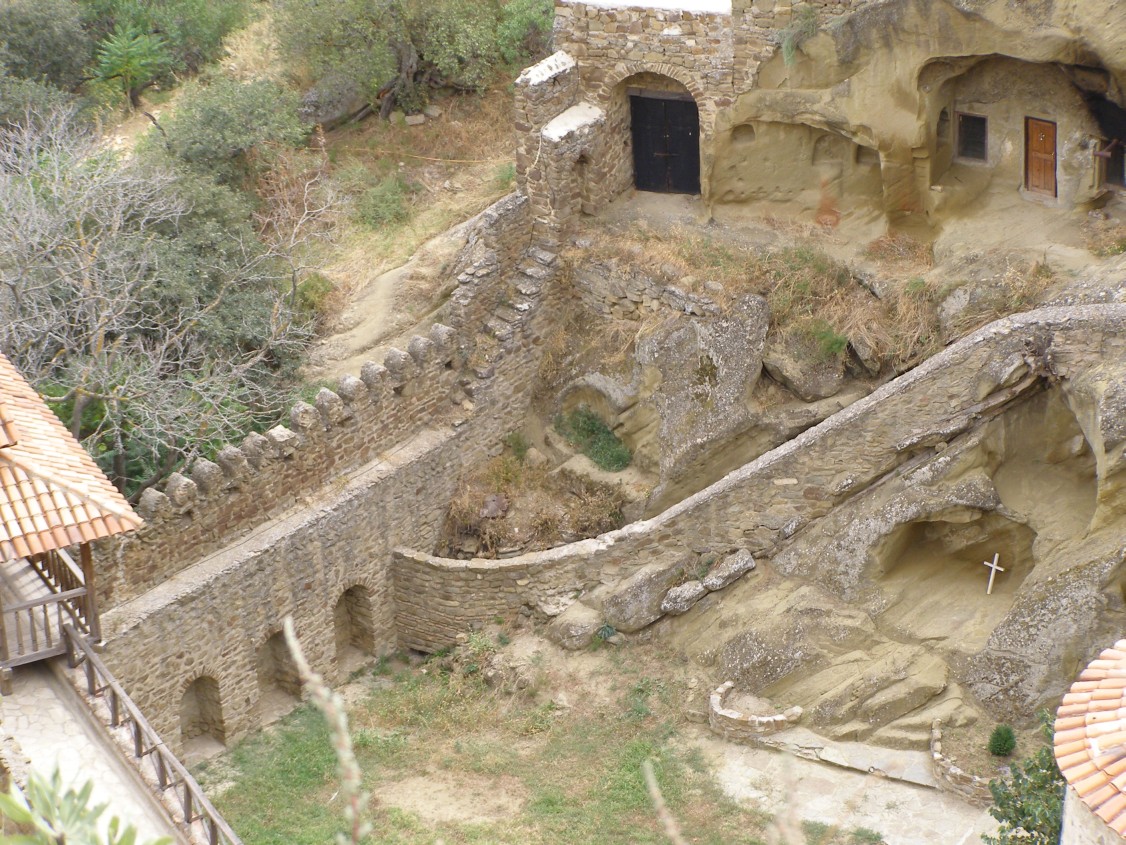
And finally, we made a day trip to Davit Gareja, a monastery that is scattered in caves all over a hill. This was truly impressive, I have never seen anything like it. To see all the caves it was necessary to hike uphill for an hour but it was well worth it.
Our last day in Tbilisi was spent hanging around our hotel and reading. Our flight home was at an inhumanly hour of 4 AM so we just left for the airport in the evening and hung around there as there was no point staying in a hotel room for a couple hours of sleep. One final stop in Istanbul on our way home, a quick trip to the city which was quite deserted early on a Sunday morning, and our trip was over.
Due to limited time we didn’t get a chance to see the Black sea side of Georgia. Or the Caucasus side of Azerbaijan. One thing I can say for sure is that now I have a better understanding of the political situation in that part of the world. The various peoples (Georgia, Abkhazia, South Ossetia, Chechnya, Nagorno Karabakh, Azerbaijan, ...) have nothing in common with each other and it is understandable why they broke free of the Soviet Union as they have nothing in common with Russia either. They each have different cultures, different languages, different religions so it is no wonder they are at each other's throats.